
Innovation workshops have become a fixture in Kuwaiti organizations. Banks, ministries, and large companies run them to generate ideas, align teams, and show commitment to change.
Many are energetic and well-attended. Few change anything. Weeks later, the ideas sit in a slide deck, the participants are back in their day jobs, and the next workshop is already being planned.
The problem isn't the format. It's that most workshops are designed as events, not as steps in a process.
What an Innovation Workshop Should Produce
Before planning anything, define the output. A workshop that works ends with:
- A clearly framed problem everyone agrees on
- A short list of prioritized ideas — not a wall of 200
- A named owner for each idea that moves forward
- Concrete next steps: what will be tested, by whom, and by when
If you can't name the decision the workshop should lead to, you're not ready to run it.
Before the Workshop: 80% of the Success
Pick one real challenge. "How can we be more innovative?" is not a challenge. "How might we reduce the time it takes SME customers to get a credit decision?" is.
Bring in customer evidence. Interview customers or frontline staff before the session. Ideas grounded in real insight beat ideas based on assumptions every time.
Invite the right mix. Include the people who feel the problem, the people who'd build the solution, and at least one person who can approve the next step. Keep it to 8–15 participants.
Secure the decision-maker. If a senior sponsor won't attend at least the final session, the outputs will lack authority to move.
During the Workshop: Structure Beats Brainstorming
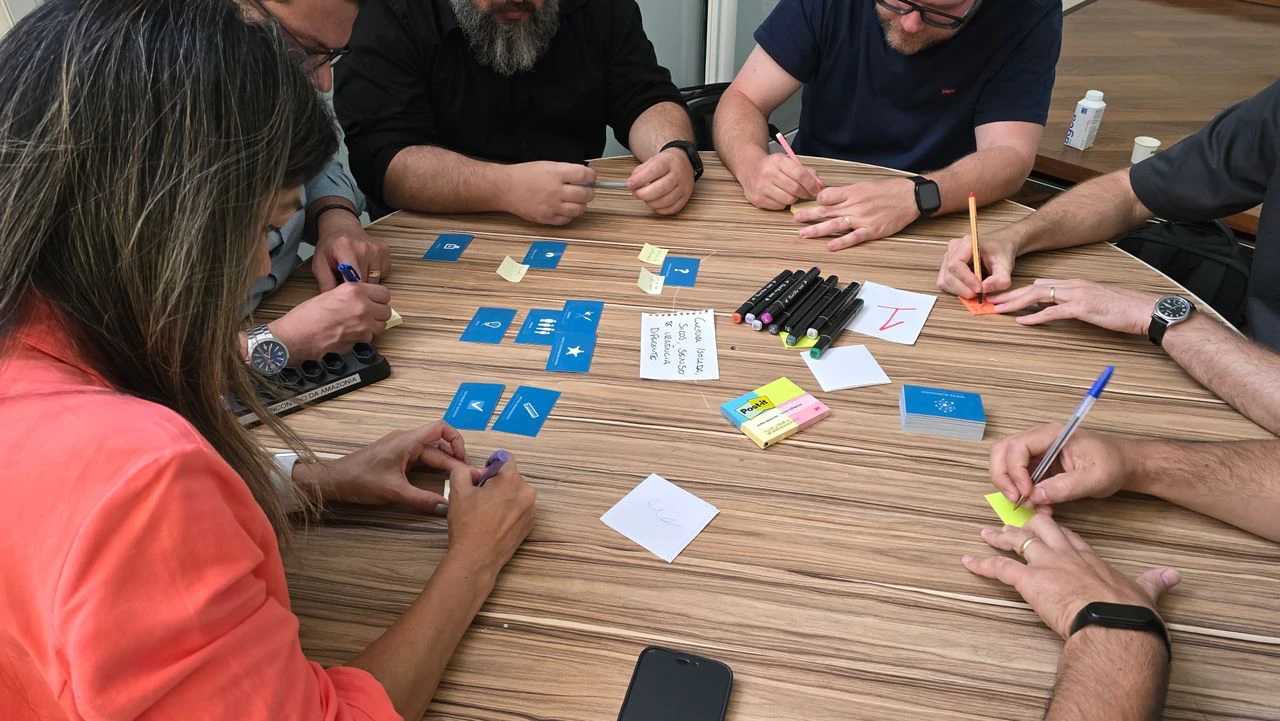
Open discussions favor the loudest and most senior voices. Structured methods give everyone an equal say and produce more — and better — ideas.
1. Share the insight. Start with what customers actually said. Use quotes, journeys, and pain points to anchor the room in reality.
2. Frame "How Might We" questions. Turn pain points into focused opportunity questions the group can work on.
3. Generate ideas individually first. Methods like Crazy 8s or 6-3-5 brainwriting let everyone produce ideas silently before group discussion — avoiding groupthink.
4. Converge with clear criteria. Use dot voting or an impact/effort matrix to narrow down. Agree on criteria before voting, not after.
5. Sketch the strongest concepts. Turn the top ideas into simple concept sketches or storyboards that someone outside the room could understand.
6. Assign owners and next steps. Before anyone leaves, every selected idea has an owner, a first test, and a date.
After the Workshop: Where Most Fail
- Share outputs within 48 hours. Momentum fades fast.
- Test before you build. Turn concepts into quick prototypes and put them in front of real users within weeks.
- Report back. Tell participants what happened to their ideas. Nothing kills future engagement faster than silence.
- Fund the next step. A workshop without a small budget for testing is just a conversation.
5 Signs Your Workshop Won't Work
- The challenge is vague or too broad
- No customer data or voices are in the room
- The most senior person speaks first and longest
- The session ends with "we'll follow up" instead of names and dates
- Nobody has budget to test what comes out
One Workshop Is Not a Program
A single workshop can align a team and surface good ideas. But real innovation needs a repeatable process: research, workshops, prototyping, testing, and decisions — run continuously, not once a year.
Run Workshops That Lead Somewhere
Sprint Innovation is Kuwait's innovation partner for corporates and founders. Through our Corporate Innovation program, we design and facilitate innovation workshops and Design Thinking programs for organizations — and we stay to prototype, test, and build what comes out of them.
Book a free 30-minute consultation and we'll help you design a workshop around your real business challenge.